Pet care you can rely on
Critter, Startup Pitch · Product and UX Lead
Critter is a marketplace for pet care in Indian cities: dog walking and pet sitting, booked in a few taps from people who've been checked. We started from one problem. Pet parents in cities can't find caregivers they trust, so they patch together services they don't.
I directed a team of seven, with one of us each on strategy, creative, finance and legal, marketing, customer experience and market research. I led product and UX. We tested demand with 150+ urban pet owners, built the site and a pilot ad, and pitched it to VCs.
-
The site: verified sitters across Bangalore, with trust badges before the search box.
-
Three memberships at ₹299, ₹599 and ₹999 a month. Each walk earns coins that pay for premium care.
-
The other side of the market: caregivers set their own hours and rates, with insurance.
-
Referrals: a free service for the friend, and reward points for both.
Sizing it from the ground up
Top-down market sizes look good on a slide and don't tell an investor much. We built ours from one city up. Bangalore has about 50 lakh pets. If 60% are dogs, that's 30 lakh dog owners. The upper tenth of that market is 3 lakh. And since many owners walk their dogs themselves or leave it to household help, we planned on reaching 1% of those in year one.
Tap a circle.
Circles drawn to scale. Every step is an assumption you can argue with, which is the point of showing them.
Trust is the product
Pet parents already have options. What they don't have is a caregiver they'd leave their dog with.
The 150+ owners we spoke to said the same thing in different ways. Price came up late. The worry was the first handover: who is this person, and what happens if something goes wrong?
So trust is on the first screen, before the search box. Sitters are verified and vetted, every profile carries its rating, support runs 24/7, and caregivers are insured while they work.
What one walk earns
The unit is a walk. A parent pays ₹300, the walker gets ₹200 and Critter keeps ₹100. An overnight stay is ₹1,000, with ₹700 to the host. Against that sit ₹4.73 lakh a month in fixed costs, mostly salaries, plus about ₹1.4 lakh for onboarding kits, marketing and referral bonuses.
At the deck's plan of 8,000 walks and 100 nights a month, that clears ₹3.17 lakh before tax. Drag the sliders to see how much of that is the plan and how much is the model.
Everything except walks and the cut is held at the deck's numbers: 100 overnight stays and ₹1 lakh a month from partnerships.
The line makes the real question easy to see. Break-even at the deck's cut is about 4,800 walks a month, and every ₹10 we give up on the cut moves it by hundreds of walks. That's the number I'd defend in the room, more than the profit.
Looking back, I'd also change how the deck counted revenue. It added up everything a parent paid, ₹26 lakh a month, and then paid the walkers out of costs. What Critter actually keeps is closer to ₹9.3 lakh.
- Parents pay26
- Walkers and hosts get16.7
- Critter keeps9.3
Source: the Critter pitch deck, April 2025
Both are true, but only one of them is the size of the business, and an investor will do this subtraction in their head whether or not the slide does it for them.
Why parents keep booking here
The bigger risk for a care marketplace is people going around it. Once a parent finds a walker they like, why keep paying a cut?
Tap a reason.
Each reason on top has to keep earning its keep after the first booking, not just on it.
Memberships are our answer. At ₹299, ₹599 or ₹999 a month, each walk earns 5, 10 or 20 coins that pay for premium care. Coins only have value inside Critter, so every walk booked outside it is a small loss for the parent too. Insurance and support are the other half. A walker you met through Critter comes with both, and a walker you pay in cash doesn't.
Two markets, not one
Caregivers are a customer segment too. Most are pet lovers looking for flexible income, and the site pitches them on setting their own hours and rates, with insurance while they work. The cost model assumed 100 new walkers a month, each with an onboarding kit.
A dog-walking marketplace in one city is really hundreds of tiny ones, one per neighbourhood. A caregiver across town doesn't help anyone, so supply has to fill a few neighbourhoods before it spreads.
Bookings that get rebooked
- Active booking ratiomonthly users who actually book
- Time to first bookingfrom sign-up to the first walk
- Coin spendingcoins earned that get spent
- Moving up a planmembers who upgrade
Those four came from the deck's key metrics, along with NPS and lifetime value per registered pet. Coin spending is the one I'd watch first. Coins that pile up unspent are a loyalty scheme nobody feels.
The deck
We also made a one-minute pilot ad, linked below.
-
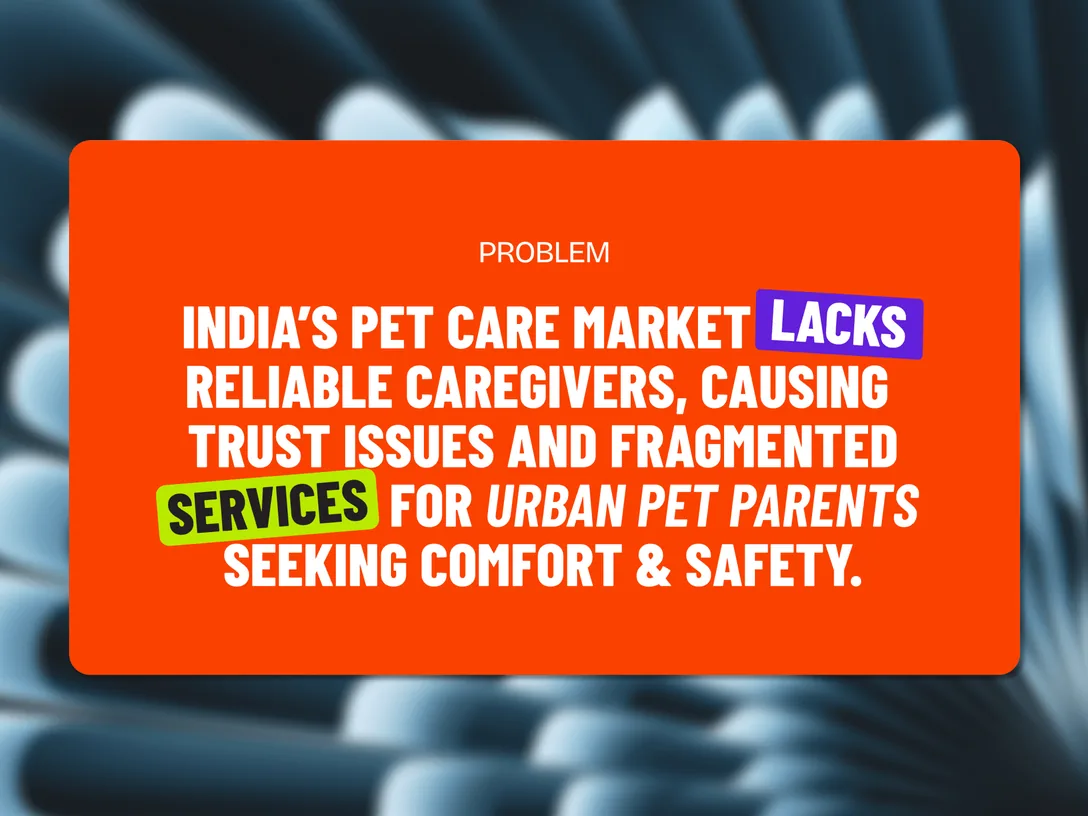
The problem, as the deck put it.
-
The solution: vetted local caregivers, easy booking, memberships with coins and perks, and 24/7 support with sitter insurance.
-
Market sizing from the bottom up, and the cost model for one month.
-
Where the money comes from.
-
The competition, and which of them is a partner rather than a rival.
-
Three customer segments, including the caregivers.
-
The metrics we said we would be judged on.
Next bets
An intake step that turns a parent's messy description ("she gets anxious around other dogs, eats at 7") into a care sheet the walker reads before arriving. It's a small use of a model, and it takes the edge off the most nervous part of handing your dog to a stranger.
During a visit, caregivers already send photos. A model could turn a day of photos and notes into one short update, so a parent at work gets one calm message instead of fifteen pings.