Money help for young Indians
FinBuddy, SDA Bocconi x Mojek Money · Team Lead
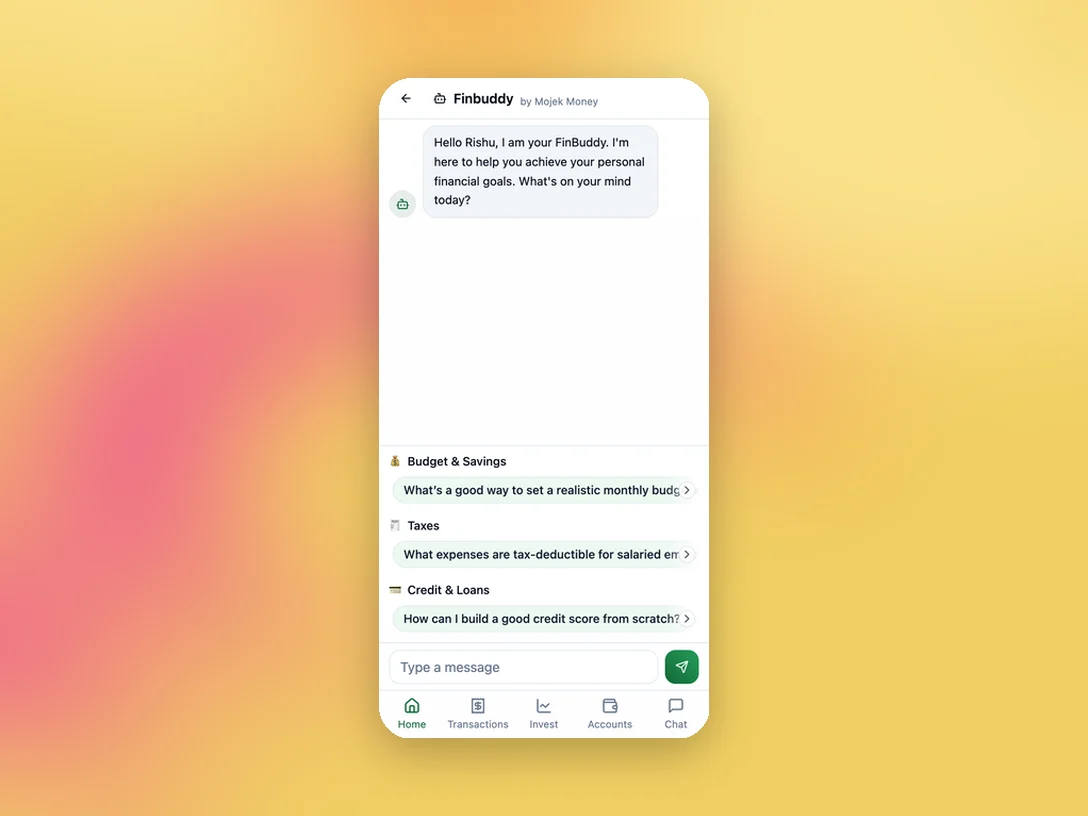
FinBuddy is an AI money assistant for young Indians, designed for Mojek Money. We built it for "La Conquista", the SDA Bocconi and Mojek Money national case competition, and placed third.
The competition drew 4,900+ registrations. I headed a team of four, the only B.Tech team in the finals, up against MBA teams from the IIMs, ISB and the NITs.
The job to be done
We framed the brief with jobs to be done: help young Indians make progress in their financial lives. Only about 27% of Indian adults are financially literate, and over 40% of young Indians keep their savings in cash or low-interest accounts. Most learn about money from parents, friends and influencers.
Our user was Rishu, 23, working in big tech. Jargon overwhelms him, and he has nobody he trusts to ask. His fear about an AI assistant was specific: that it would be generic, wrong or insecure. So the first answer had to be simple, personal and right, because it's the one that decides whether there's a second.
-
The prototype opens by name and offers three kinds of question to start from.
-
An answer in steps, with the sources it used, follow-up questions and a beta disclaimer.
-
Asked again, it said it could not find a reliable answer rather than make one up.
The other four tabs are placeholders. The chat was the part we had to prove.
One number to steer by
I set the north star: weekly verified resolutions. It counts unique conversations in a week where the question was resolved and the user rated the answer 3 or more.
Tap a word.
A money assistant can look busy while doing harm. Message counts go up when answers confuse people, and time in the app goes up when they're lost. A resolution only counts if the user says it helped.
Each user also gets a north star of their own, tied to the goal they set, like a house deposit or a first investment. The general number tells Mojek whether FinBuddy works. The personal one tells Rishu whether he's getting anywhere.
Weekly verified resolutions
- Value and adoptionfirst-question conversion, time to first value
- Answer quality and trustmisinformation flags per 1,000 questions, personalisation rate
- Engagementfeature retention, follow-ups
- Businesstickets avoided, premium upgrades
- Tech and opscost per verified resolution, p95 latency
Every answer from somewhere
"Verified" had to mean something in the system too. A planning agent reads each question and routes it to a specialist, and every answer is grounded in a knowledge base we built from vetted sources: regulators, banks and tax authorities, with a trust score on each source.
Tap an agent.
We mapped ten real questions to exactly what each one needs. Some need only public data, some only the user's own, and the hard ones need both. Pick one.
"I want to buy a house in 2 years. What budget should I look at?"
The Labubu question is my favourite. It needs no outside data at all, and it's still the hardest to answer well, because a good answer is about Rishu's cash flow and not about Labubus.
Three ways it could go wrong
We named the failures before they happened, each with the fix built into the design.
A confident answer from last year's tax rules is the worst thing this product can say.
Knowledge also has to keep up. We designed a plan, do, check, act loop around the knowledge base: gaps found from real questions, fixed quickly, reviewed by experts and checked against regulations, with weekly reports on what changed.
-
The problem. Only about 27% of Indian adults are financially literate, and most young people learn about money from friends and influencers.
-
Rishu, 23, works in big tech. His fear is that the AI will be generic, wrong or insecure.
-
Ten real questions, each mapped to the public sources and the Mojek data it needs.
-
The system: a planning agent routes each question to a specialist agent, and every answer comes from the verified knowledge base.
-
Plan, do, check, act. How the knowledge base stays current.
-
The north star, the ten metrics under it, and three ways it could go wrong.
-
The roadmap: two workstreams over two months.
What I'd do next
The roadmap ran two workstreams over two months, and we projected up to 90% less time to a decision. That's a projection, and the first thing I'd do with a real launch is measure it.
I'd also build the answer key before scaling the assistant. A few hundred real questions from people in their first jobs, with correct answers written and dated by someone qualified, is what "verified" gets measured against. When the prototype couldn't find a reliable answer, it said so. I'd keep that behaviour and count how often it happens.