Less load on speech therapists
SpeechWise, Smart India Hackathon '24 · UI/UX Designer
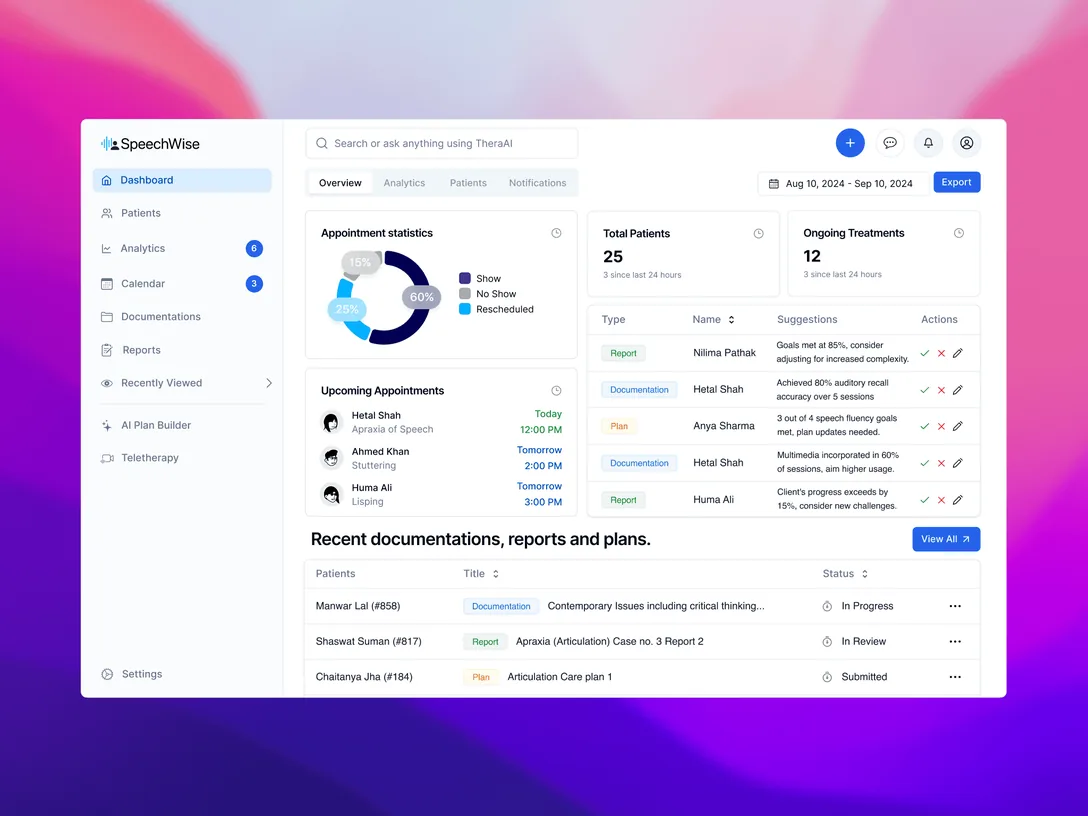
SpeechWise is a contextual speech therapy platform: a SaaS tool for 3,000+ therapists who together serve 1.3M patients. The goal was to make their day-to-day work simpler.
I led a team of five as the UI/UX designer. We reworked the workflows so the tool explains what it's doing.
The brief, in one number
Split across 3,000 therapists, 1.3M patients works out to about 430 each.
When one person carries that many, every minute of admin is a minute that doesn't go to a session.
That's why every minute of admin matters at this scale. Drag it and watch one therapist's week.
Forty working hours over five days, one block for each hour.
The tool couldn't add work, not even the work of figuring out the tool. So the rule was simple. A therapist should never have to wonder why the software suggested something. Every suggestion shows what it's based on, and the therapist can overrule it straight away.
What changed
In therapist simulations, the reworked flows cut cognitive overload by 40%.
Designing for tired experts
Therapists know their field far better than any software does. They don't need to be taught. They need less to hold in their heads at the end of a long day.
That changes what "simple" means. It doesn't mean fewer features. It means the next thing to do is always obvious, patient history shows up where the decision gets made, and nothing important sits three screens deep.
The note written three times
The admin therapists resented most wasn't scheduling. It was writing the same progress note three times: once for the file, once for the parents in plain words, and once for the child's school. So the reworked flow writes it once, and the other two are drafts of the first that the therapist reads and signs.
Every suggestion in the tool carries a "because" line under it, like "because the last three sessions scored under 60% on /r/". It's one line of small text, and it's the reason a tired expert can accept a suggestion in a second instead of opening the history to check it.
Why simulations
You can't run a clinical study in a hackathon, so we measured load in simulated sessions. It's a real signal with real limits. It shows the design is easier to use. It can't show that patients get better faster, and I wouldn't claim it does.
We measured load with a NASA-TLX questionnaire after each simulated session, once on the old flow and once on ours, so every therapist was compared with themselves.
Speech is the hard part
Any AI feature here runs into one problem first. Speech recognition models are mostly trained on typical speech, and they struggle with exactly the speech a therapist works with. Add Indian languages and people switching between them mid-sentence, and an off-the-shelf model will get things wrong in ways a therapist can't afford.
That rules out letting a model make clinical calls. It leaves plenty of room for a model that drafts and a person who decides. It's also health data, so consent, where recordings live and who can hear them all need to be settled before a feature ships, in line with India's DPDP Act.
Next bets
Session notes are the obvious next step. A model drafts the note from the session and the therapist signs it off, the same ask-first pattern I later built into agents at IBY. Since the tool already explains itself, therapists have a reason to trust the draft.
Progress over weeks is the second. If sessions are recorded with consent, a simple measure like how many target sounds a child gets right can be charted over time. Parents get something they can understand, and therapists get a check on their own instincts.
The third is practice between sessions. Most of the progress in speech therapy happens at home, where nobody is watching. Short exercises with basic feedback, reviewed by the therapist, would stretch each session further.
Leading the team
There were five of us. Two designed, two built the front end and one owned research and the pitch. The call I had to make as lead was cutting the patient-facing app we'd planned, to put the time into the therapist dashboard. The judges would see one flow in depth, and the therapist was the user carrying the load.